The train yesterday was packed. People stood in the aisles, babies shrieked and babbled, and no matter how many stops we lingered at along the way, no one seemed to want to get off. I guess it was Füssen at the end of the line or bust.
I’m lucky though. Seeing my overstuffed backpack and purse, someone was kind enough to offer me one of the fold-down seats — about a foot away from the swivel-door to the restroom.
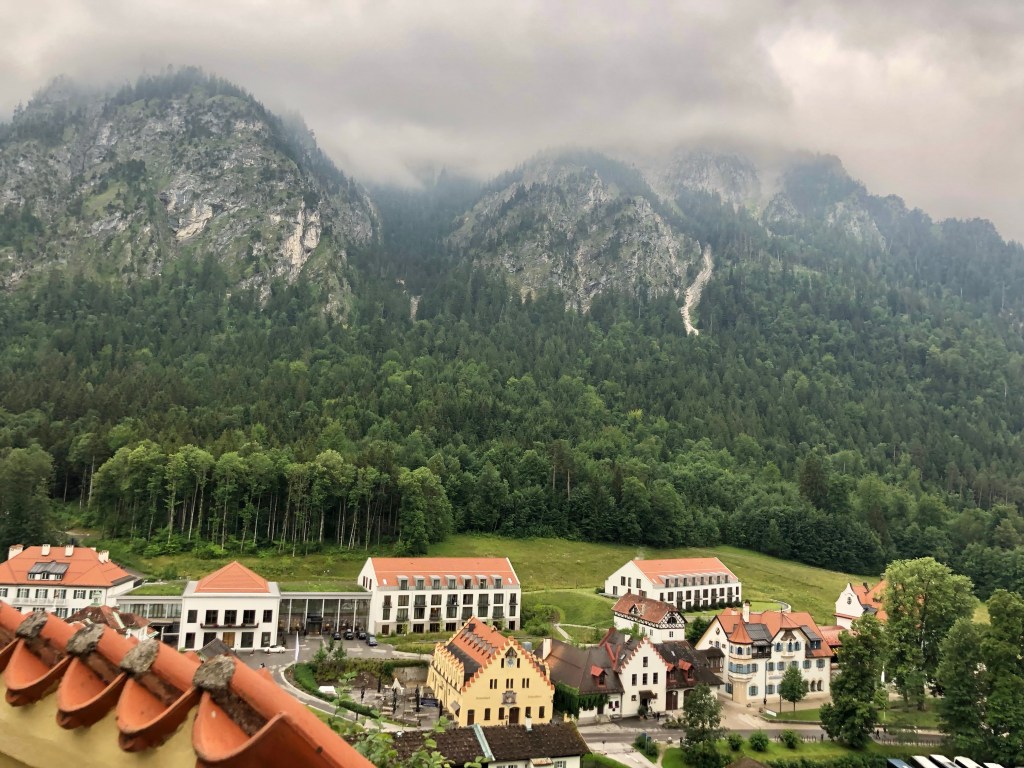
Füssen is a little village, southwest of Munich, nuzzled up against the Austrian border. Switzerland lies a bit further below. As I go south, I’m approaching the alpine “yodel-ay-hee-hoo” region of Europe. And as I arrive, I can see the sheer faces of mountains on the horizon for the first time.
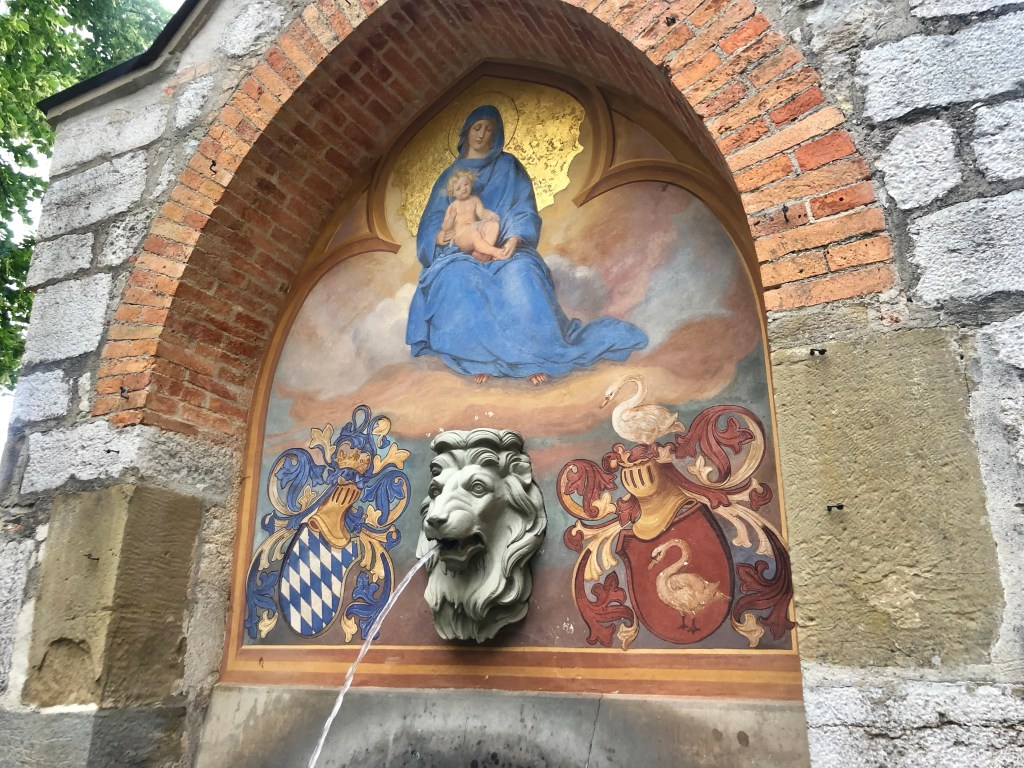
Füssen (the name literally translates to “Feet”, and they have a coat of arms to match) began as a monastery in medieval times. Today it is also a tourist resort, winter sports centre, and customs station.
Two famous Bavarian castles (“Schlösser”), Hohenschwangau and Neuschwanstein, sit nearby, and these grand pieces of architecture are the main purpose of my visit. The castles were projects of Bavarian rulers, a father and son from the House of Wittelsbach. Their home was the Residenz in Munich which I visited previously, but they (like many people today) enjoyed the area around Füssen as a remote retreat. Here’s the history of these castles in a nutshell.
Hohenschwangau: A ruler’s vacation home — and an artistic attempt to legitimize his power.
Maximillian II, one of the first of the Bavarian kings, renovated this medieval castle. Colorful, romantic murals on the walls of each room tie his own family legacy to medieval history.
Neuschwanstein: A fairytale castle, renovated (at impractical expense) by a daydreaming young king.
Ludwig II took the throne at age 18 after Maximilian II’s sudden death. He lived in a fantasy world, retreating from public life and going into great personal debt to work on architecture projects. He was a superfan of Richard Wagner (at one point paying off the composer’s personal debts), and his renovation of Neuschwanstein was inspired by the medieval myths that Wagner put to stage. At age 40, Ludwig was declared insane and forced to abdicate — after the royal cabinet became fed up with his reclusive lifestyle, homoerotic tendencies, and impractical spending.
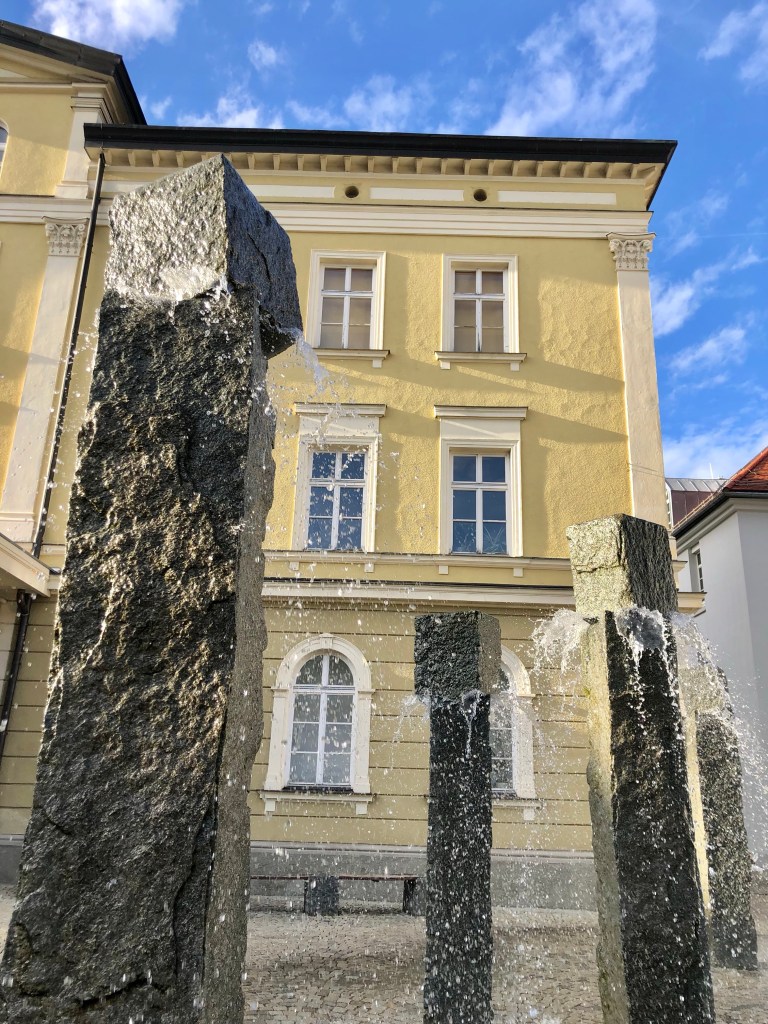
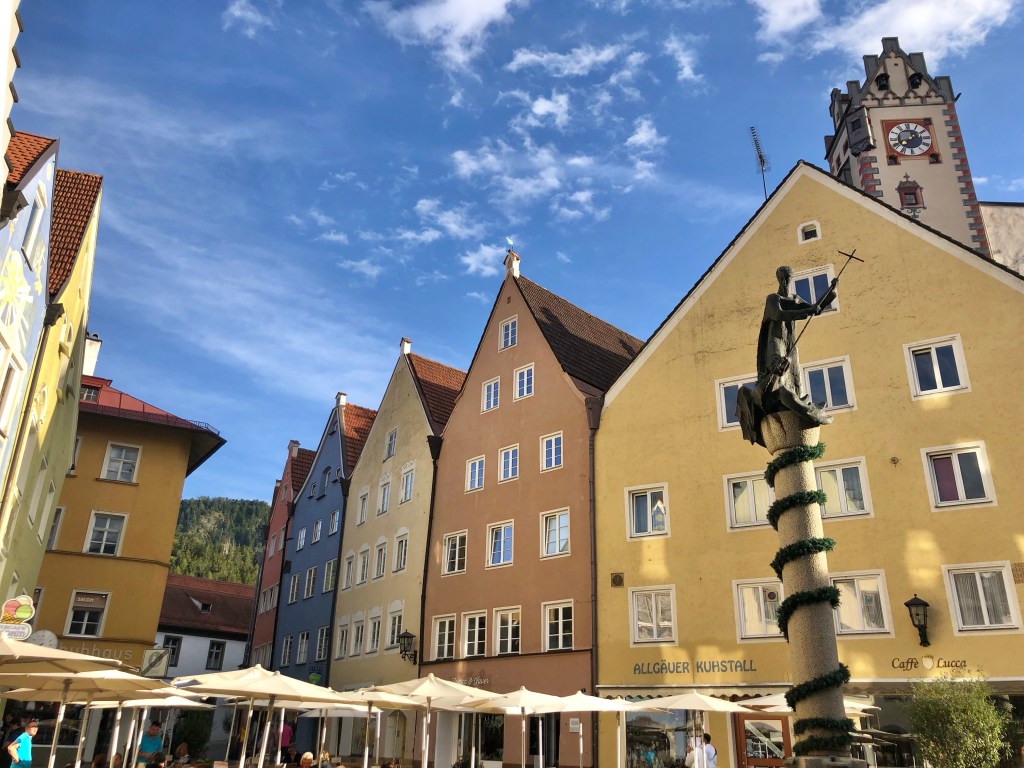
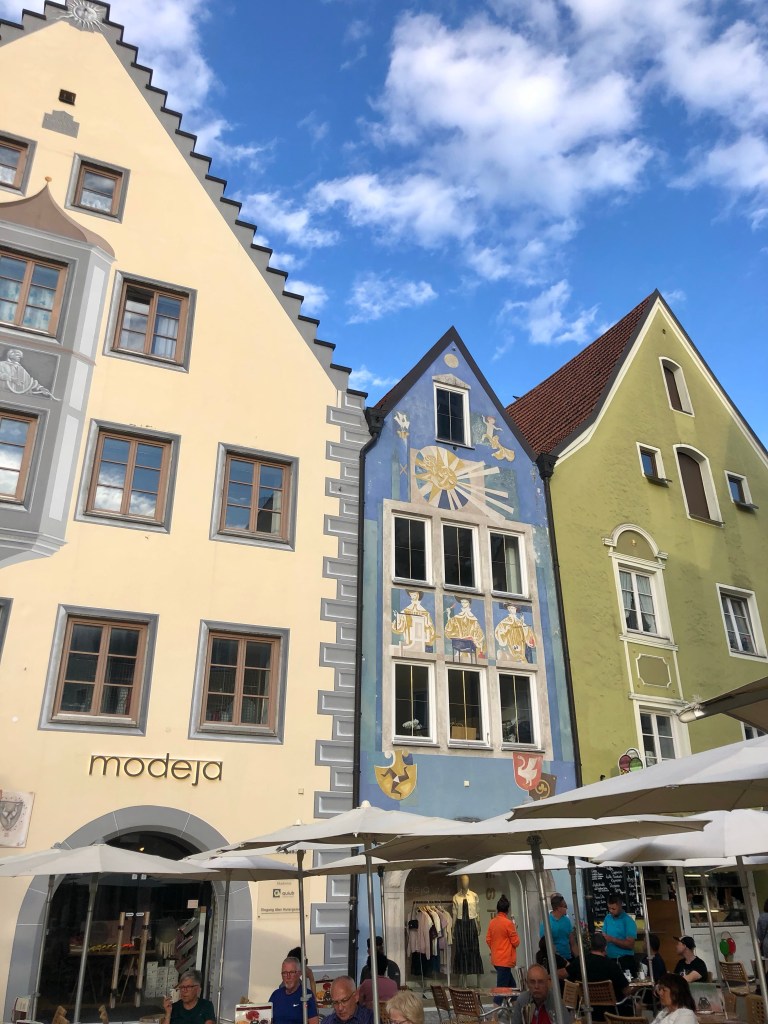
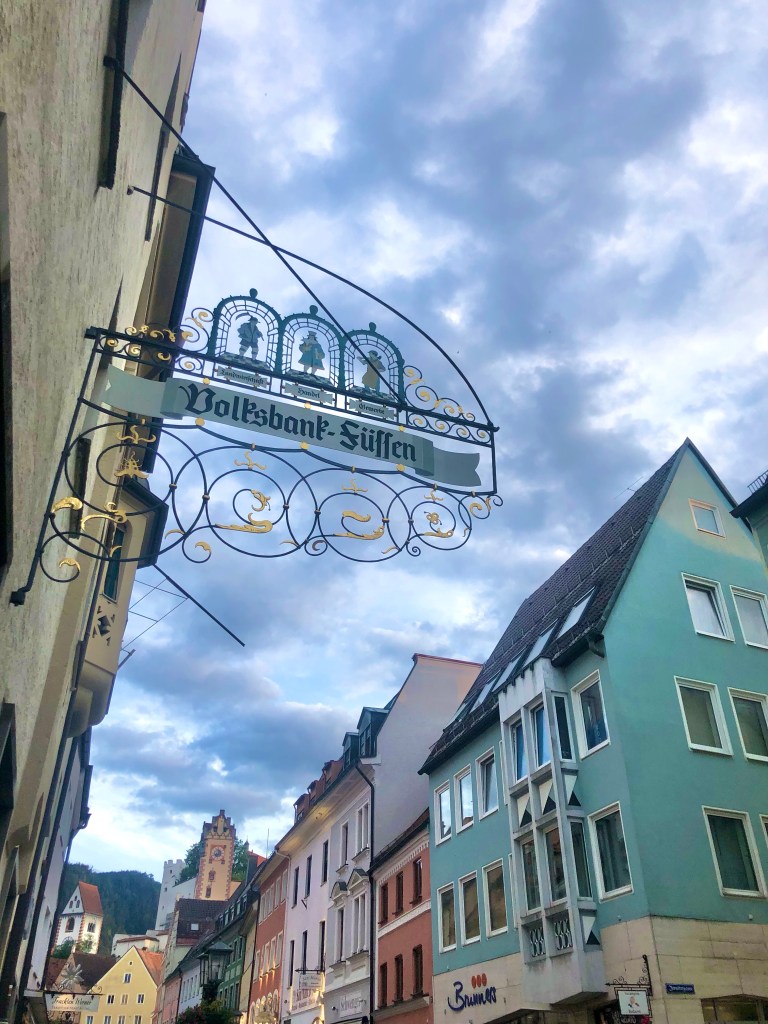
I had a relaxing first night strolling around in Füssen. It’s always refreshing to switch from a city destination to the country, and vice versa. Füssen is very small and has a similar “tourist town” feeling to Rothenburg o.d.T.
For dinner, I had some classic Bavarian noodles at a small restaurant.
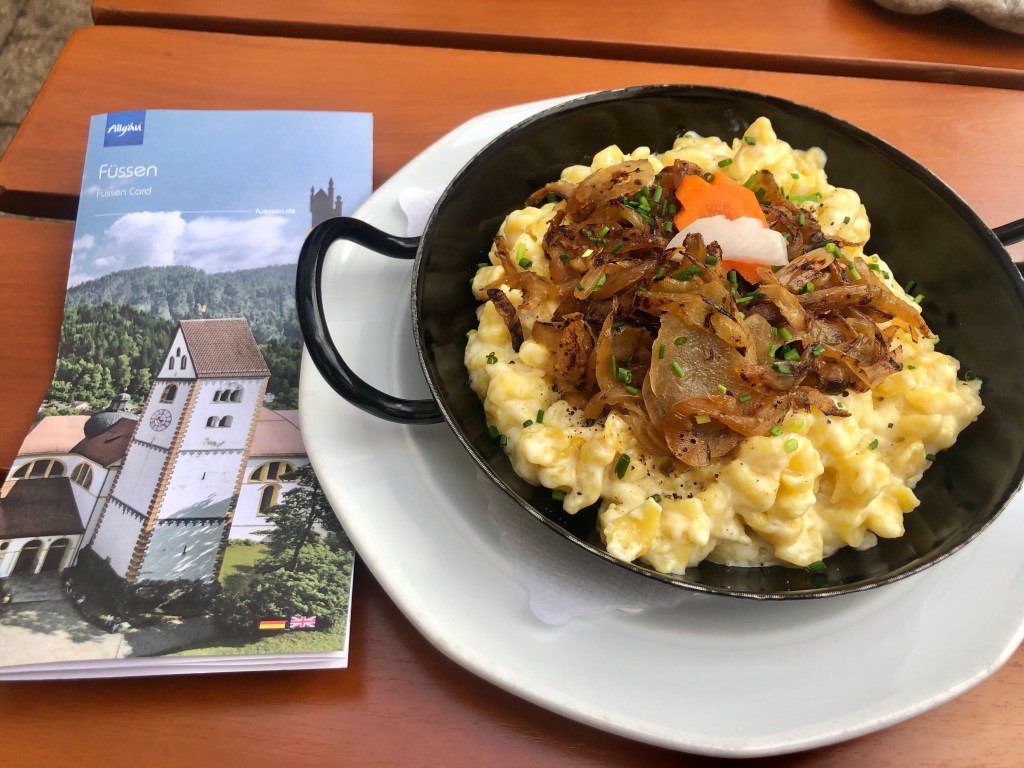
What fun it is to be in this region!! I feel like music from Beauty and the Beast could start playing at any moment. (Ballroom dancing in a castle like Belle and the Beast did is definitely a life goal, by the way)
Also nearby (north of Munich) is Ingolstadt, a town featured in one of my favorite classic books from the old English major days — Mary Shelley’s Frankenstein. Ingolstadt was the location of the German medical school where Victor Frankenstein made his monster, known in the book as “the Creature.” On a rainy, gloomy day like today, I can see how Mary Shelley came up with the idea of a killer monster lurking in the mountains. (Creating an undead monster man with my medical degree is definitely another life goal, by the way (but unlike Victor, I’m not going to abandon MY BEAUTIFUL GIANT SON!))
My hotel this time is an adorable local inn. Red and white checker print, cows, and hearts all serve as decorative motifs, and the staff wear Dirndls.
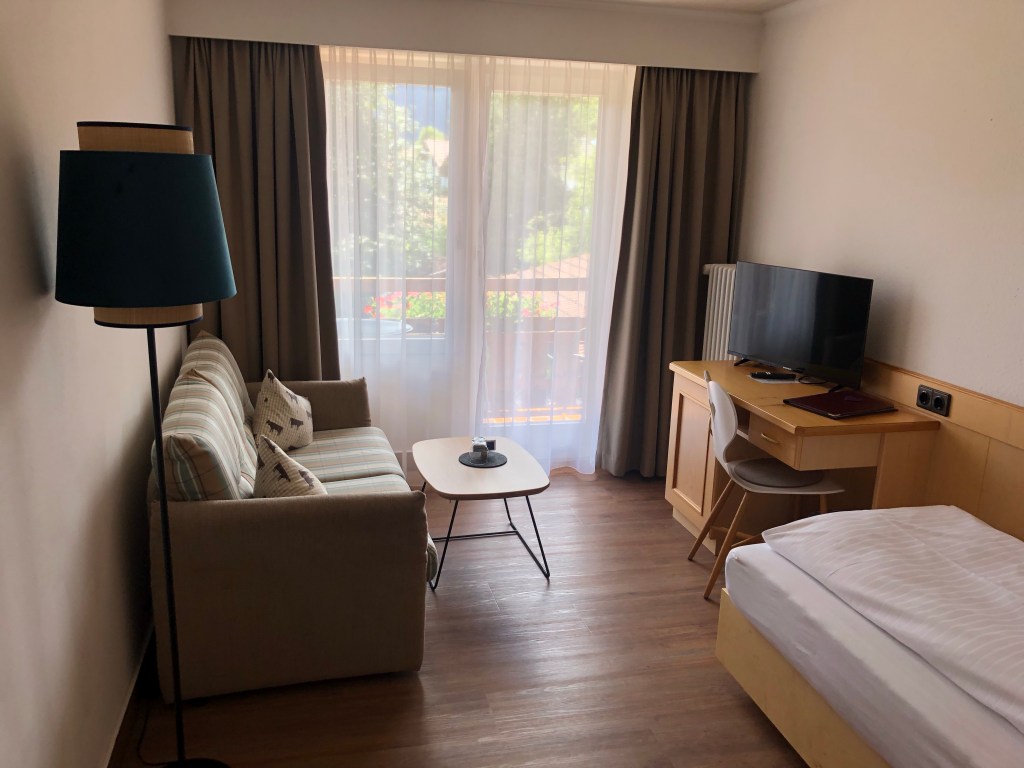
I had another breakfast buffet this morning, where I filled up on local cheese, sausage and toast before heading out on my journey to the first Schloss. A bus ride and short hike later…
I was surprised to find that Hohenschwangau’s exterior looked pretty… Spanish? I’m not sure why, but it could have something to do with the fact that several Wittelsbachs married Spanish princesses.
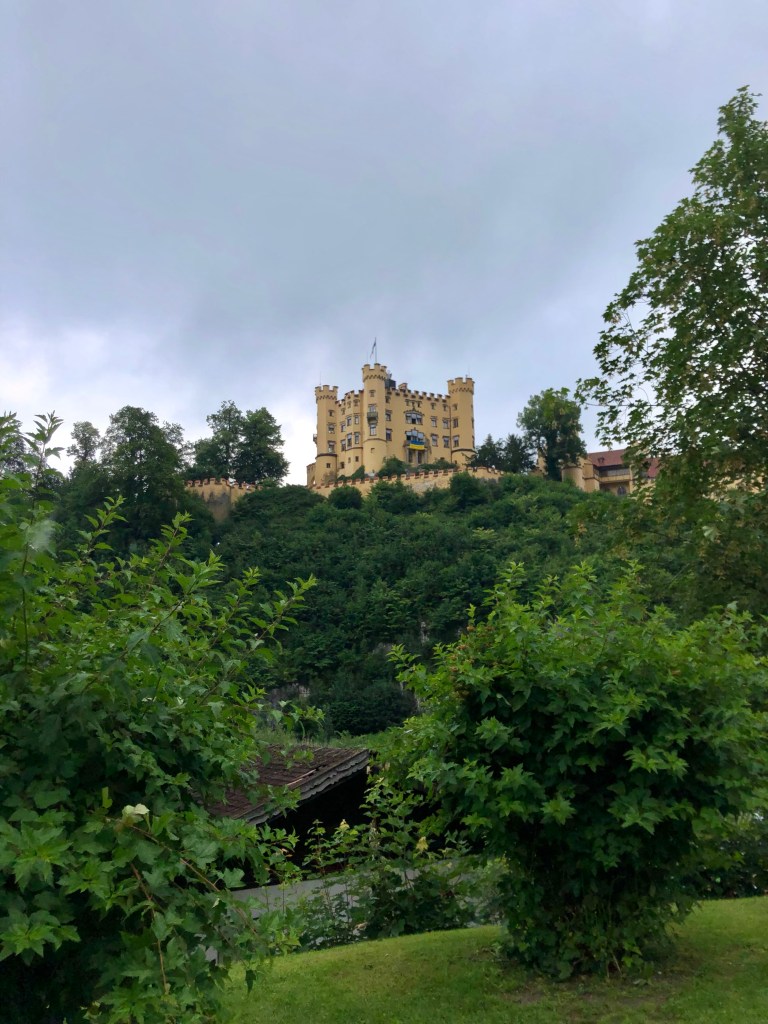
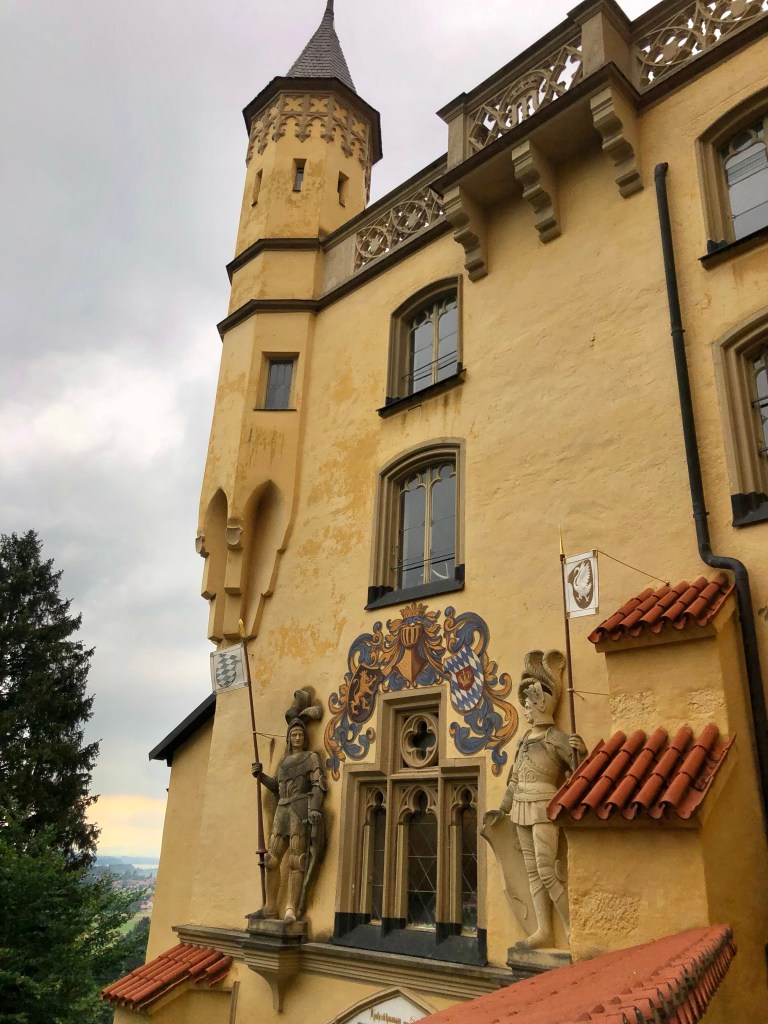
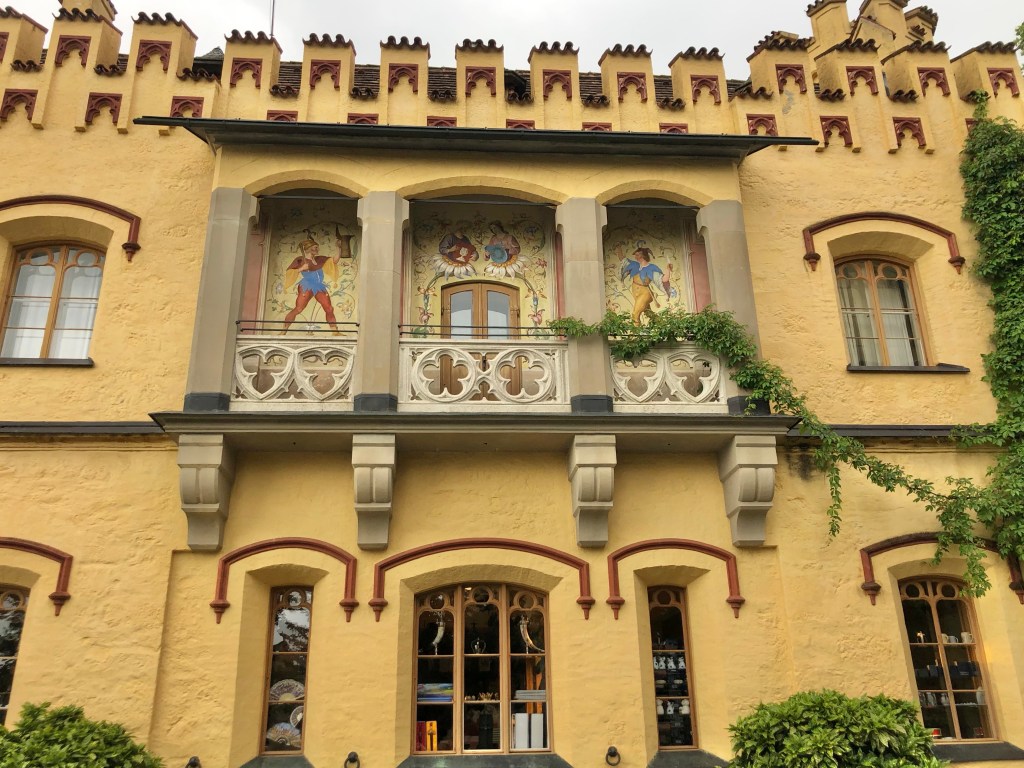
Internally, however, it’s (I believe) Neogothic, and the Spanish influence disappears.
Also, the stewards of this castle seemed to have something stuck in their craw. No photos allowed inside!
The castle was beautifully decorated, full of silver and gold treasures. Probably the most striking features were the paintings inside the castle. Almost every wall was painted with some sort of Romantic historical, mythical, or royal family scene; in one room, the ceiling was painted with stars.
My group was rushed from room to room, where we all listened to a short, dry audioguide, usually about a minute long and often prompting more questions than providing answers. (Ex: “Observe the bust of the young king Ludwig II, who abdicated when he was declared insane. Now proceed to the next room.”) It felt like there was a lot between the lines, if you know what I mean.
The next stop I visited, The Museum of the Bavarian Kings, filled in some of those gaps. (Again, no photos allowed. God damn.)
According to the museum, the Bavarian royal family was unique because of their peaceful rule and “sensitivity” to the desires of the people. The Wittelsbach family had been around for centuries, but essentially got promoted from dukes to monarchs of Bavaria in the 1800s, starting with King Maximillian I in 1806. Maximillian’s descendants were kings of Bavaria until Louis III was overthrown in a socialist revolution in 1918. Louis III’s son, prince Rupert, later lead a Bavarian monarchist opposition to Hitler.
It seemed like (unless the museum was highly biased… which is certainly possible) most kings in the line were generally benevolent and well-liked, and coexisted well with democratic institutions. Except for maybe Ludwig II… but his eccentric personality eventually made him a beloved icon as well.
Bavaria was wealthy, promoted the arts and sciences, and had relatively liberal social policies.
The independent kingdom of Bavaria did not last long after 1806, however; it was incorporated into the Prussian-led German Empire in the 1871, then became a state of Germany after 1949, after feuding with Hitler. The museum noted the Wittelsbachs were anti-Nazi and some were even sent to concentration camps. The current head of the House, Franz, was imprisoned in several concentration camps during the war, including Dachau.
The aforementioned modern-day Wittelsbach head, Franz, has made no claim to the throne. After the death of his father, he changed his own “courtesy” (non-legal) title from “king” to “duke” of Bavaria. Today he is 88 years old. He seems to enjoy a peaceful life with his longtime partner, Dr. Thomas Greinwald, and their daschund. A well-earned retirement, I’d say.
As the museum notes: “Bavaria is not the Wittelsbachs, and the Wittelsbachs are not Bavaria. They are merely one of Bavaria’s many faces.”
Still, I feel like the museum was hesitant to talk about the sinister side of royalty or the Wittelsbachs, if there is one. Maybe a research topic for later? But it is remarkable that they were generally so well-liked, educated, and even anti-Nazi. Perhaps they are what you’d call model royalty!


6 responses to “Day XVI + XVII: Hot gossip about German royalty! Castles! Feet!”
Amazing photos!! Neuschwanstein is the basis of one of my favorite board games: Castles of Mad King Ludwig. If you happen to be near Otterberg, I highly recommend a visit to my childhood home ☺️
LikeLiked by 1 person
Wow!! I definitely need to play that board game now! 🏰
LikeLike
I’ve visited here several times and am always amazed by the sheer beauty of the area and castles. I think Ludwig II drowned under mysterious circumstances in his lake by his castle. Rumors were that the people of Bavaria were feeling the pinch of his excessive spending and speeded up his demise. But they’ve certainly recouped the money in current times ironically from tourism due to his castle! Loved this post!
LikeLiked by 1 person
I forgot to mention he died mysteriously the day after being declared insane! He and his psychiatrist (who he was friendly with) went for a walk together one evening and were both found dead in the lake. Not sure if there was foul play, or if it was an “escape attempt”? There are several theories.
LikeLike
Looks enchanting there.
Ludwig’s era coincided with an epidemic of neurosyphilis, a condition that manifests itself with a wide variety of mental illnesses, and filled the asylums in the 19th century to bursting. I demand a disinterment!
LikeLike
Lovely photos! The castle looks moody and foreboding as well as beautiful. Please proceed with using your degree to create that undead monster man – I want grandchildren!
LikeLike