Per title, I’m traveling 5 hours east today, through Vienna — and then into the nation of Hungary and it’s capital, Budapest. Hungary is in Central Europe. Above me will be Slovakia + Poland, below will be the Balkans + Greece, and further east will be Romania + Ukraine (don’t worry — Russia would start WWIII if they randomly attacked Hungary, an EU nation).
I’m assuming that you don’t know a lot about Hungary. Honestly, I didn’t either.
Hungary is a landlocked country in Central Europe. In Hungarian it is called Magyarország, or “Land of Magyars.” One unique fact about Hungarians is that they speak a language that is not related to any other major European language. Hungarian is from the Uralic family of languages — only related to Finnish, Estonian, and other small languages spoken in northern Scandinavia and the Russian Federation.
This means if you rely on your knowledge of English to sorta-kinda-maybe understand other Germanic languages, then your strategy REALLY isn’t going to work in Hungary. The language does not even operate by standard “subject-verb-object” order (ex: “He eats the apple” in English, “Er isst den Apfe” in German.) Actually, the Hungarian language freely shuffles around subject, verb and object in order to add emphasis or signify the important part of the sentence.
I find Hungarian fun and fascinating, for the record! It is so alien to English that I’d compare learning it to learning Japanese. Though, Hungarian is a bit easier than Japanese, since the lettering system is at least similar to English.
Anyway —
Culturally, Hungary has distinct folk traditions (which have sadly faded away in the last 100 years) and celebrates its own Christian holidays. It is known for its cuisine, which often features rich red meat and lots of yummy grease. In a menu of traditional Hungarian food, you’ll probably find goulash, beef stew, and paprika.
Linguistically surrounded by alien nations, Hungarians felt isolated through much of their history. This may be the reason why after Christianization they became attached to Latin, which became the language of culture, scholarship, and state administration—and even the language of the Hungarian nobility until 1844.
Hungary found itself on the losing side of WWI and WWII, then under Soviet control until the 90s. One unfortunate event has defined much of the political rhetoric in Hungary: at the end of WWI, the defeated country lost 71 percent of its territory to several of its neighbors as a result of the Treaty of Trianon (1920), including 40% of the native Hungarian speakers. Since then, grappling with the loss of more than two-thirds of their territory and people, Hungarians have looked to a past that was greater than the present as their collective psyche suffered from the so-called “Trianon Syndrome.”
The desire to get the land back was widespread prior to 1945. Hungary joined Germany in WWII with the hope of gaining some of its former territory; Germany did indeed grant some of the land to Hungary at various times throughout the war. However, after the defeat of the Axis, Hungary’s post WWI borders were restored. Resentment over Trianon was suppressed during Soviet domination (1945–90); and it reemerged during independence in 1990, when it took on a different form. The modern country appears to be split into two irreconcilable factions: those who are still concerned about Trianon and those who would like to forget it.
About the Treaty of Trianon, a Hungarian I spoke to told me “yeah, they’re still malding.” (malding = Gen Z slang, “to be so mad that the stress makes you start balding.”) Bringing up the subject with random people is a faux pas — akin to bringing up abortion or gun rights in the US.
This split is evident in most aspects of Hungarian political, social, and cultural life. Today, the country’s elections are still dominated by its radical right wing party. Sadly, this has resulted in the recent passage of legislation such as anti-LGBT laws… and the forbidding of private, nongovernmental groups from helping Muslim refugees. In fact, Hungary was infamous during the refugee crisis for building a barbed-wire fence along the length of its Serbian border in order to prevent refugees from entering.
Hungary joined the EU in 2004, though there’s certainly a transition to traveling there. For example, the country’s currency is the Hungarian Forint. One Forint is worth 1/400 of a Euro. It will take me a moment to judge how much things cost; it was pretty convenient that the U.S. Dollar and Euro are worth about 1:1 right now.
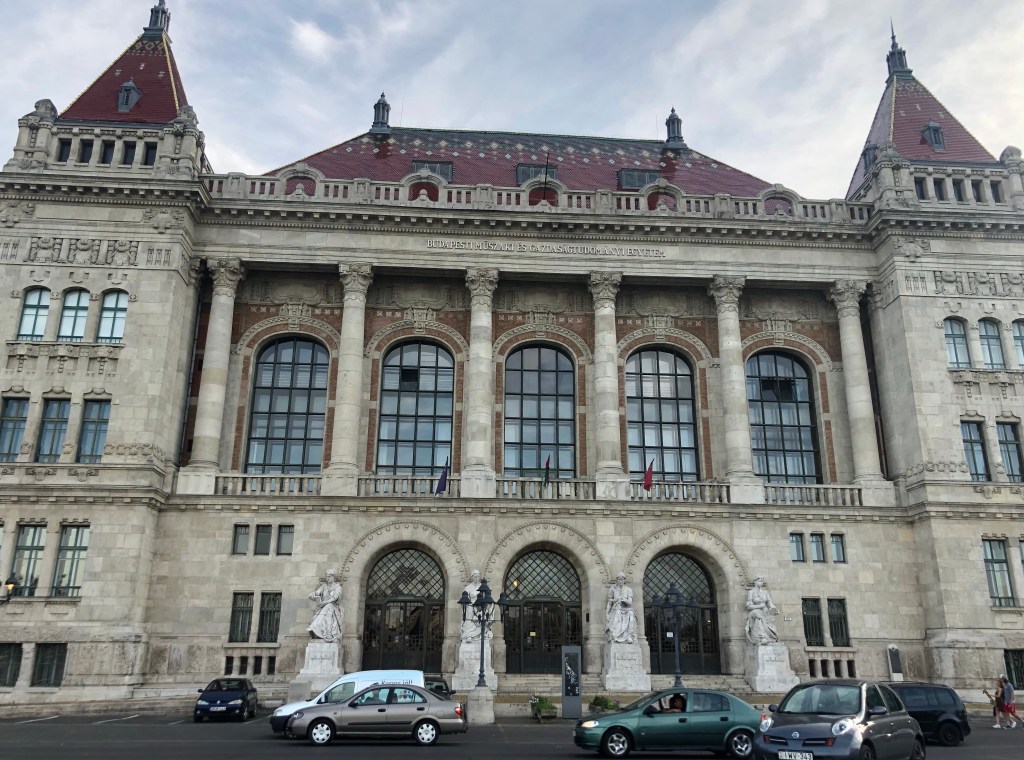
But let’s talk about something more fun: the bustling urban centre of Budapest. This city has been called the “Queen of the Danube,” and “The Paris of the East.” It has two parts, Buda and Pest, which are situated on opposite sides of the Danube river.
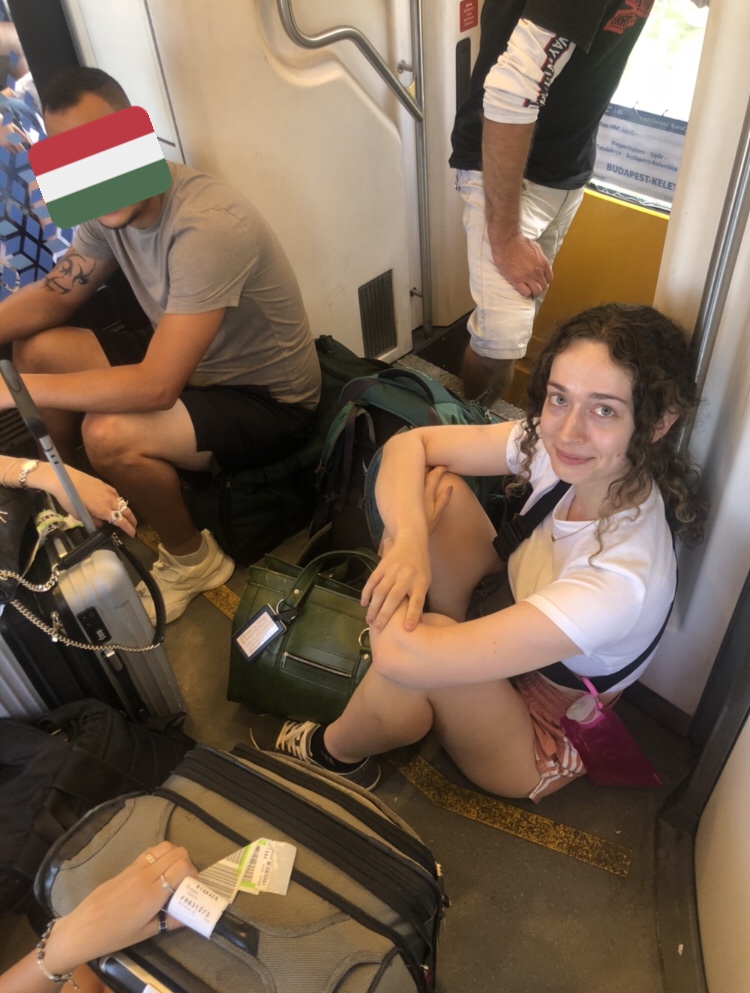
I had 5 minutes to make my connection in Vienna, so I ran and barely made it onto the train to Budapest. It was full. A small group and I sat near the commode for the 2 hour journey. As I always say, you can’t have a luxurious European vacation without sitting on a few pee-stained floors.
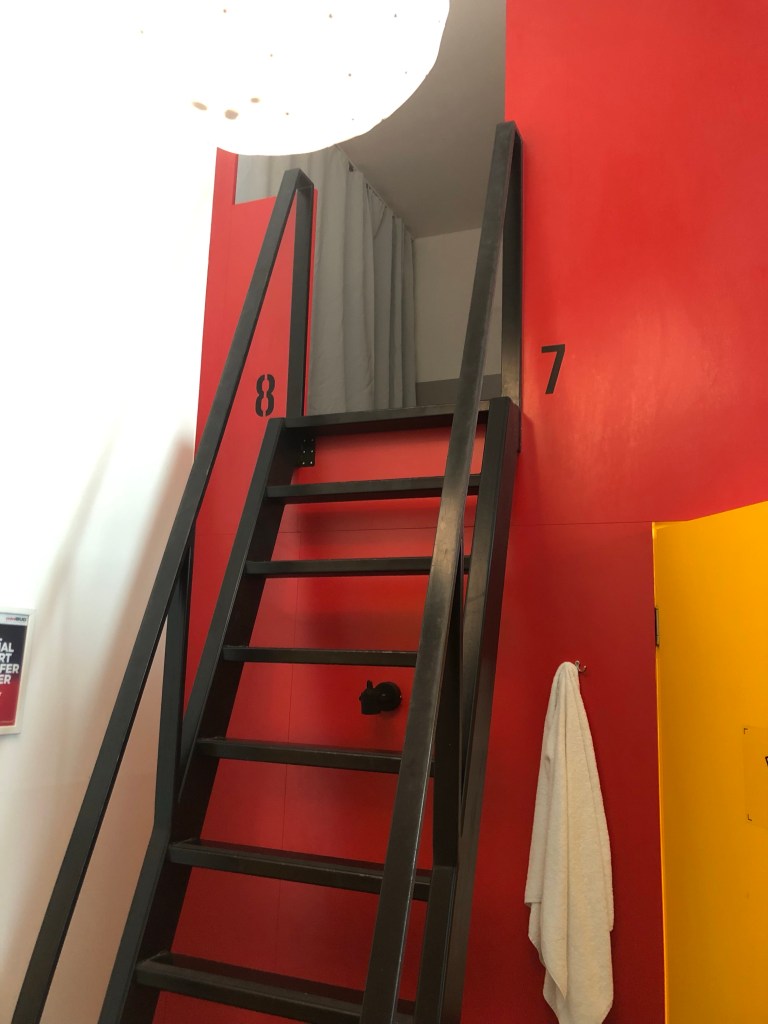
Then I made it at last to my hostel in Budapest! To be blunt, this hostel is very nice and makes the one in Salzburg look like Sheiße. Everyone in the 8 person bedroom gets their own “cubicle” with a privacy curtain and outlet nearby. Upstairs is a kitchen with free coffee and tea. There’s also an AC unit in the bedroom, though annoyingly, at least one of the other women here has thrown her wet clothes on top of it to dry, so the cold air isn’t really dispersing very well.
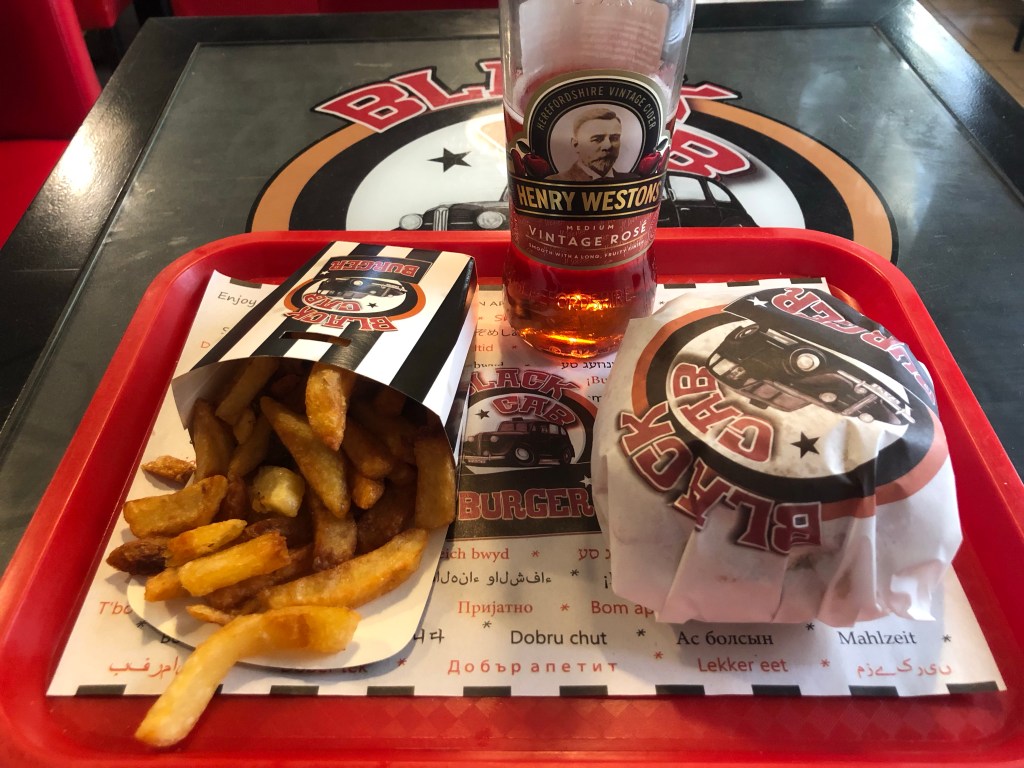
Also, I got some recommendations on where to go from a lovely Hungarian back in Omaha. So I went to a local fast food joint, Black Cab Burger. I was turned away because they didn’t accept Visa or Euros, so I went to a random ATM and got 5,000 Forint. Well worth it!
The next spot I walked to was an e-sports bar called BarCraft. This place serves up nerdy cocktails and allows patrons to play an assortment of games.
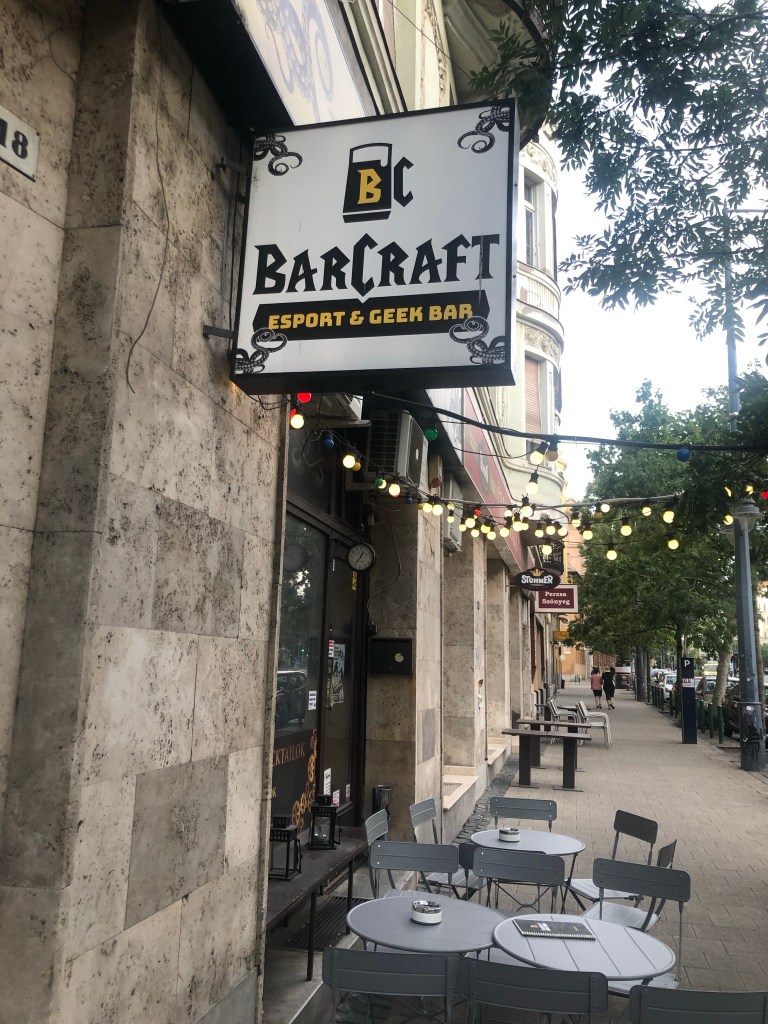
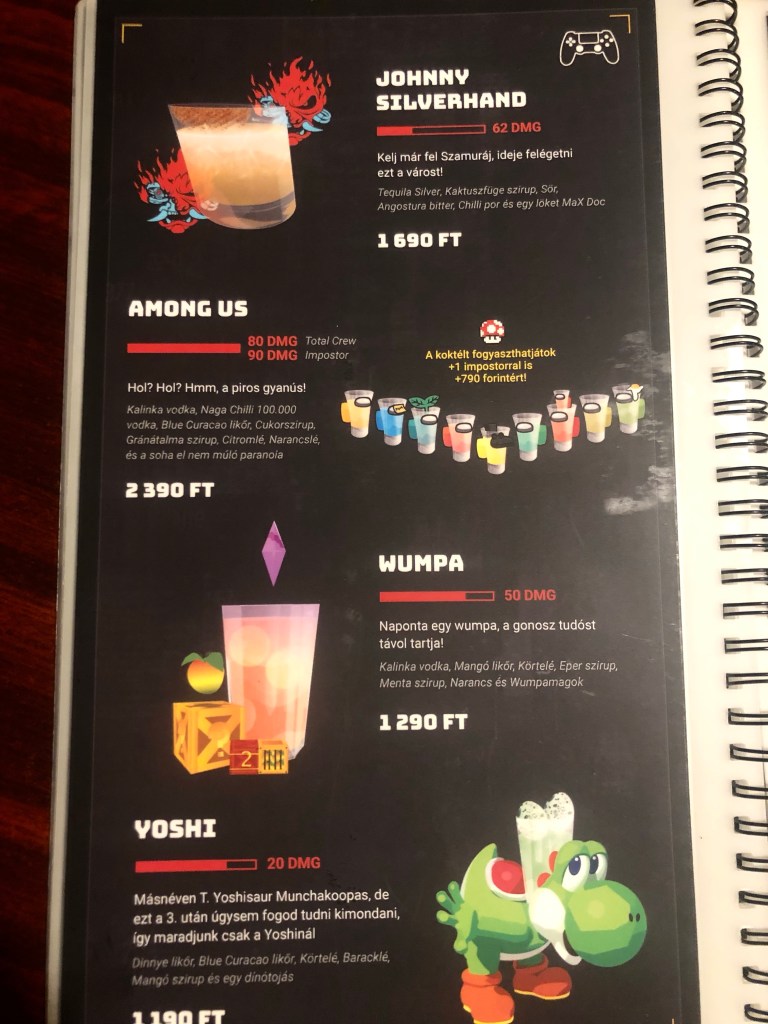
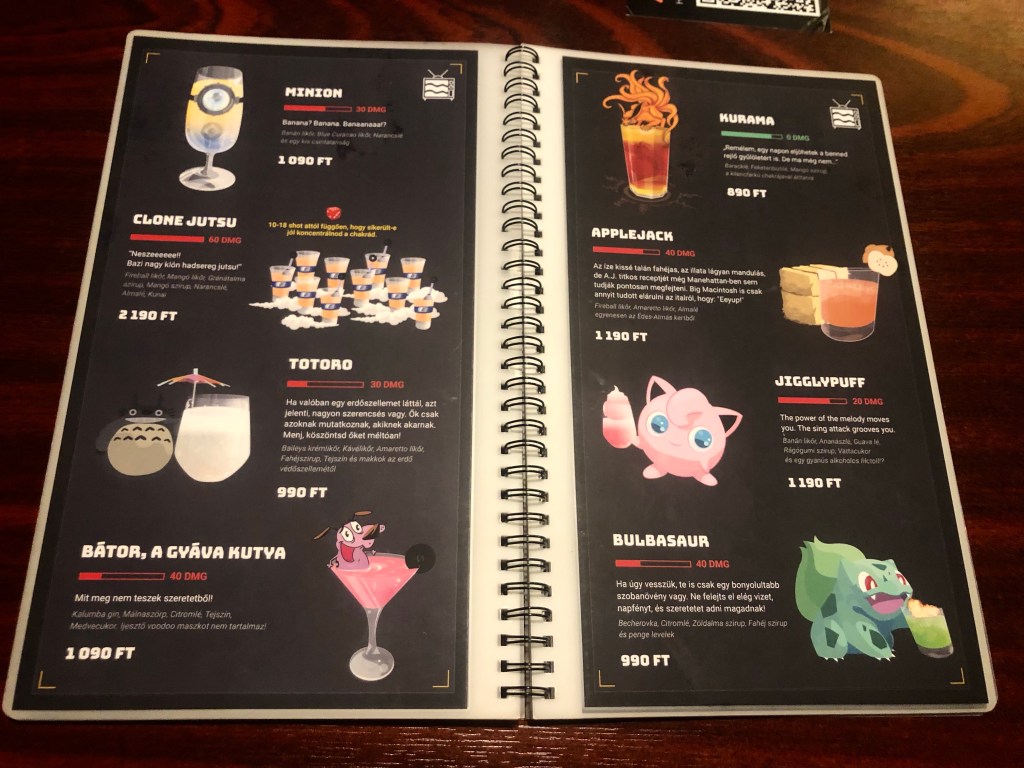
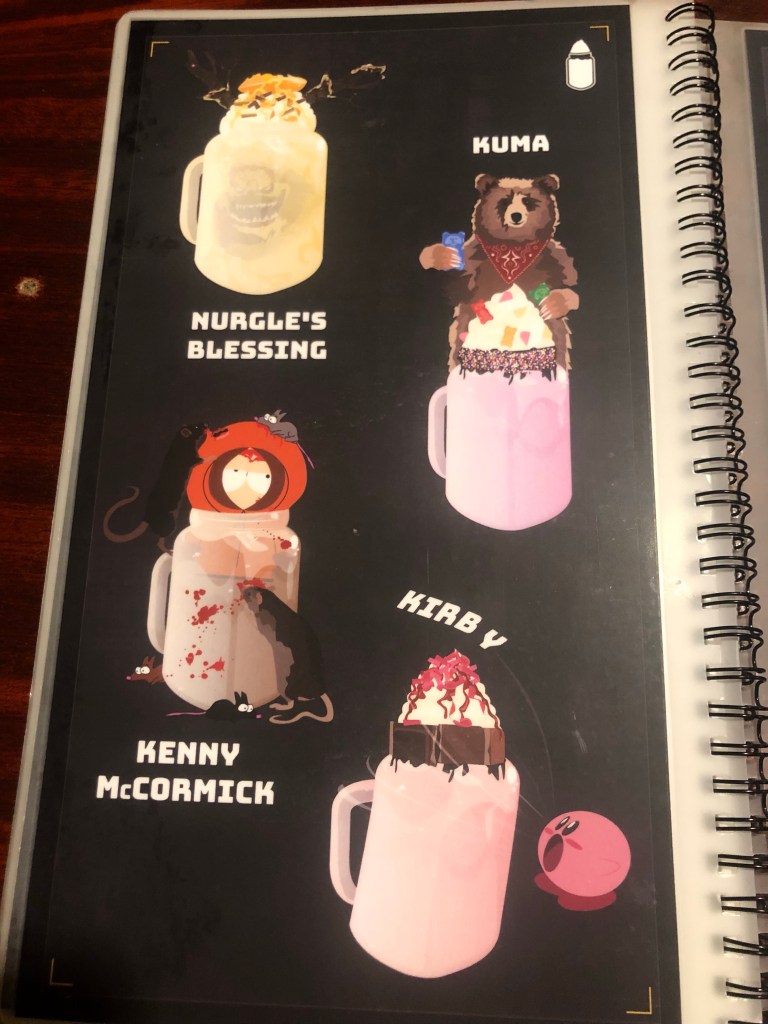
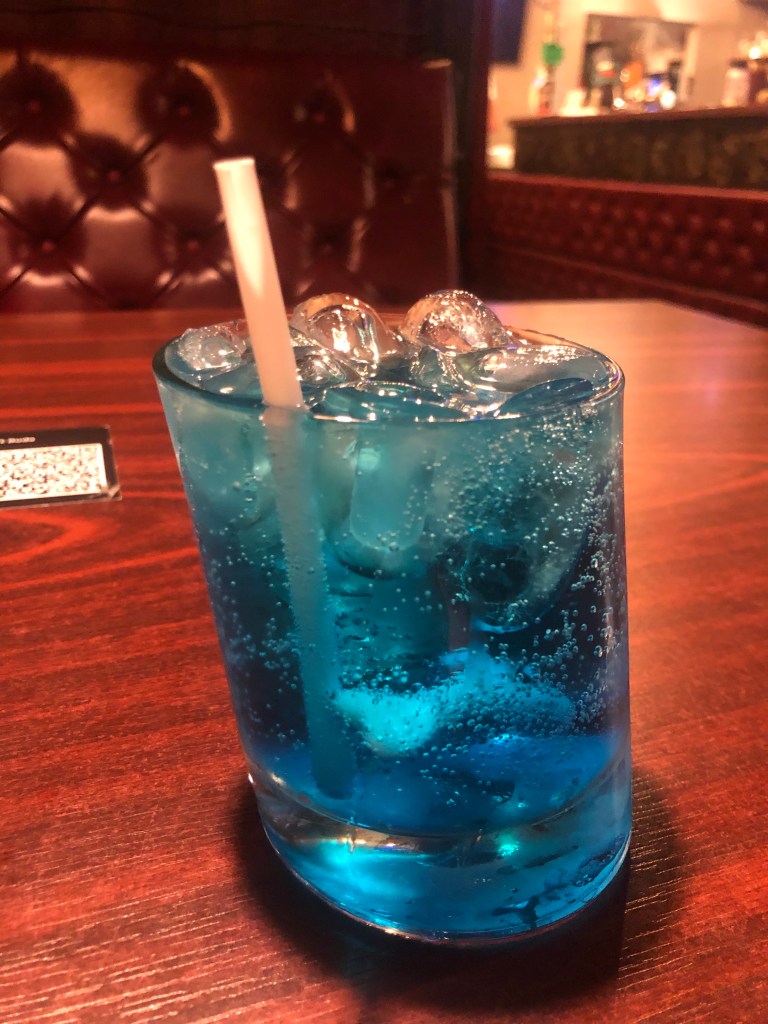
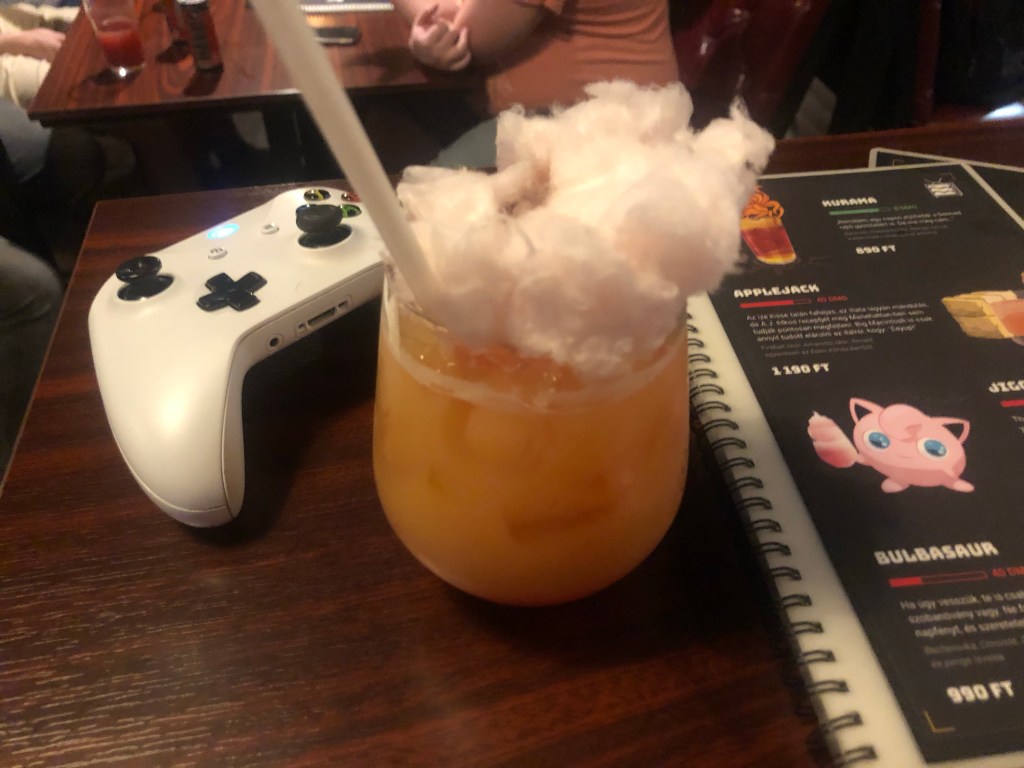
The bartender was really sweet. At one point he came up to me while I was playing Mortal Kombat 11 and said “…Can I ask a question?” When I answered yes of course, he said “My English… is it terrible? 🥺” Like many Europeans, he worried about his English despite speaking it very well and clearly! I tried to reassure him.
According to him, most young Hungarian people nowadays learn English in school. English language skills are not as common among the older generation, who grew up during Communist occupation and were made to learn Russian.
By the way, I genuinely feel as if I am living like royalty. Keep in mind that a dollar is ~400 Forint. This means that most of these elaborate craft cocktails are about $3 USD. Unbelievable — in the US a “nerdy” theme cocktail would run you at bare minimum $5, but most likely $8.
My tasty blue cheese and egg burger was 1300 Forint, also a little over $3 USD.
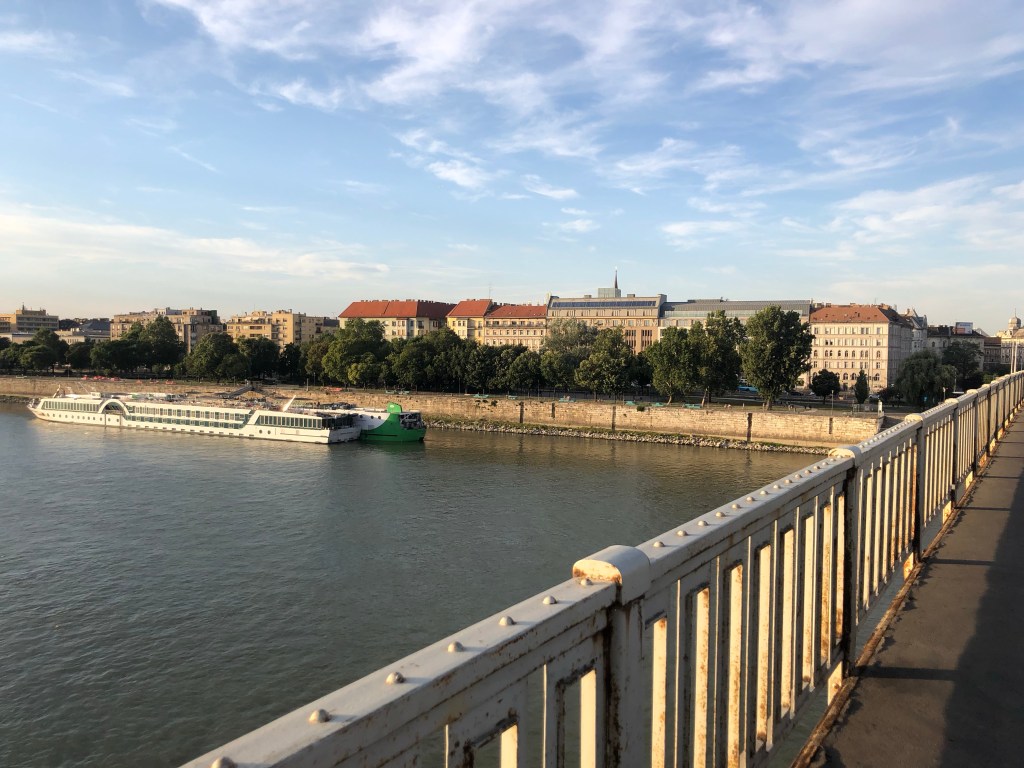
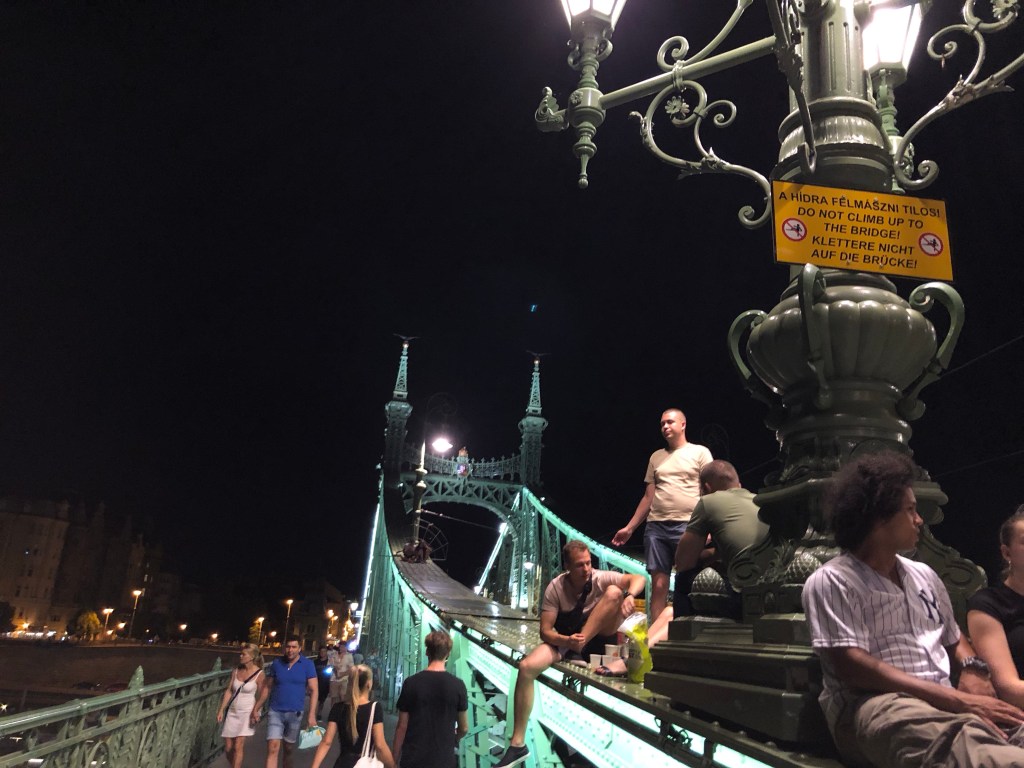
I walked back in the dark, over a beautiful bridge. Not to worry; Budapest is a very safe city.
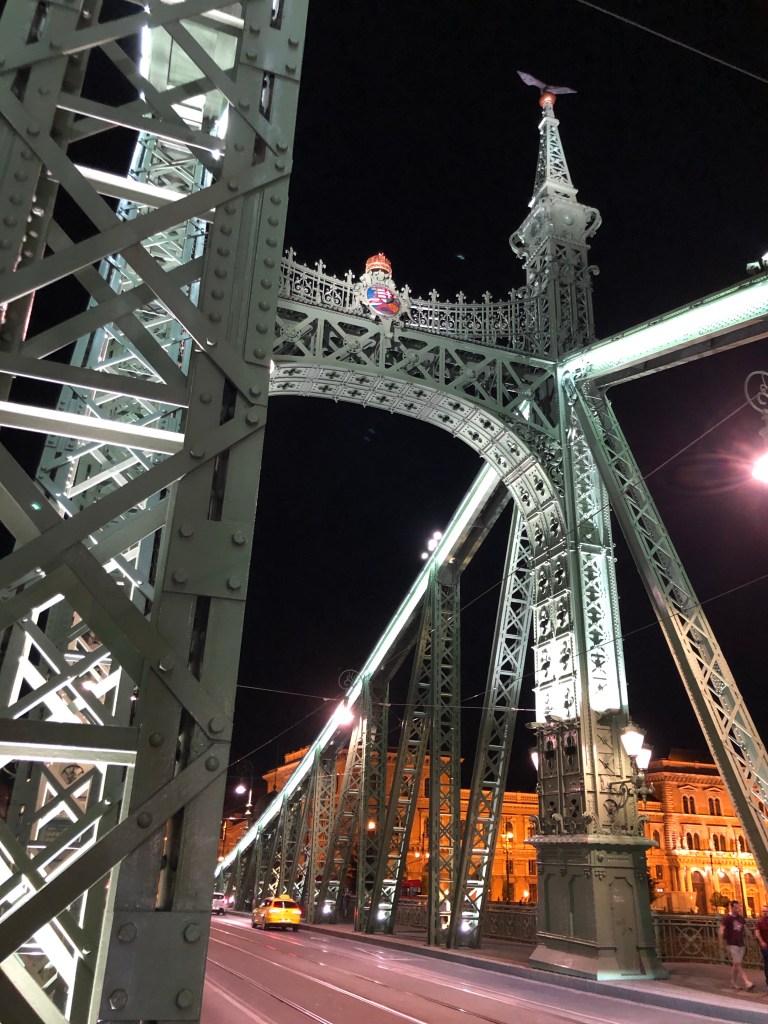
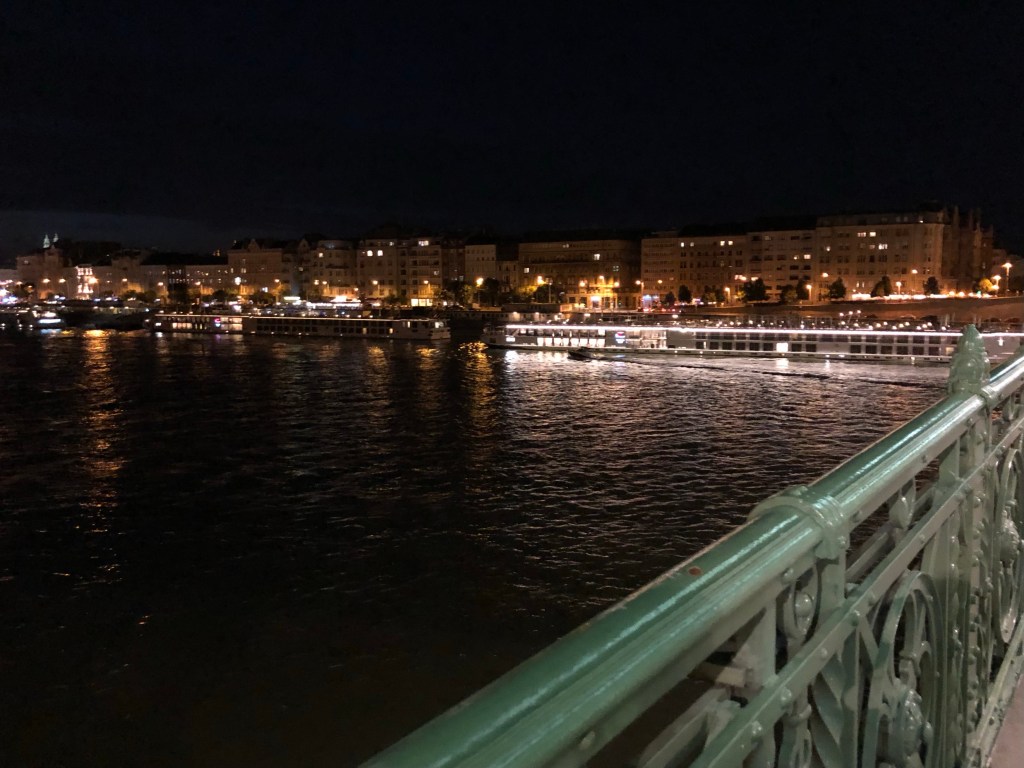
Tomorrow, I hope for some more decadence! I can’t wait to explore the area!
 Eva Adventures
3 responses to “Day XXI: What the hell is Hungary, and why should you care?”
I really liked your bog through Salzburg. Grandpa and I never stopped there. We just drove the outskirts of city. But Sound of Music hadn’t been made yet so it was just another city at the time🥲
Oooh opportunities lost!
Your description of Budapest and history is so interesting. Hungary’s history, even post WWII, is just a blur to me.
Enjoy the rest of your days there and your day in Amsterdam. ❤️
LikeLike
Thank you! I hope you did find it interesting! I genuinely knew nothing about Hungary before this. I still know nothing about some of the neighboring nations, like Slovakia. Traveling to these areas, or meeting friends from them, always makes me more interested!!
LikeLike
You really know how to cover lots of ground while traveling! Hope you are having the time of your life.
LikeLike